Jiayu Xiao
I am a third-year undergraduate student at Harbin Institute of Technology, Shenzhen.
I am currently a research intern at Alibaba Group, advised by Zhi Zhang, working on AI infrastructure.
Previously, I was a research assistant at the Chinese University of Hong Kong, Shenzhen, advised by Minchen Yu.
I am interested in systems for machine learning, efficient inference, and the low-level details that make large-scale AI systems work.
I also led Chronix, a first-prize OS kernel project in the Computer System Development Capability Competition, under the guidance of Wen Xia.
Email /
Projects /
Writing /
GitHub /
Zhihu
About
I'm drawn to systems where algorithms meet hardware, and to the constraints that decide whether an idea survives contact with a real machine. The solutions I admire are the ones that cut to the actual problem — through decoupling, or through reframing, rather than through force. I'd like to help shape what AI becomes, not just watch it happen.
|
Selected Work
When Shards Fly: Cross-Tensor In-Flight Conversion for Low-Latency, Low-Memory Weight Updates in Disaggregated RL
Jiayu Xiao, Ye Wang, Zhi Zhang, Jiarui Guo, Kan Liu, Tao Lan, Minchen Yu
arXiv preprint, 2026 / arXiv / PDF / Code
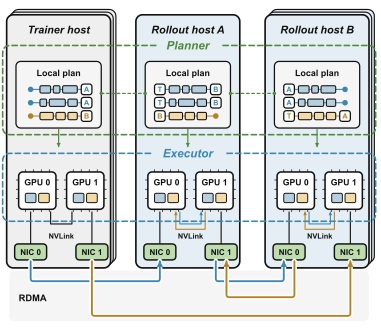
ShardFly speeds up policy weight synchronization between training and rollout GPUs in disaggregated LLM reinforcement learning. It reuses cross-tensor transfer plans and fuses layout conversion, quantization, communication, and destination writes in a persistent GPU kernel. Across five models and four baselines on up to 32 H20 GPUs, BF16 weight updates ran 1.26–27.92× faster. End-to-end Qwen3-30B-A3B GRPO response-token throughput rose 5.49–6.71% over veRL NCCL.
Janus: Disaggregating Attention and Experts for Scalable MoE Inference
Zhexiang Zhang, Ye Wang, Yumiao Zhao, Jiayu Xiao, Qianjing Yang, et al.
arXiv preprint, 2025 / arXiv / PDF
JANUS disaggregates attention and MoE layers into independently provisioned GPU worker pools, couples them with adaptive two-phase communication, and uses microsecond-scale activation scheduling plus SLO-aware scaling. It improves per-GPU throughput by up to 4.7× while meeting token-level latency SLOs.
Chronix: A Multicore Monolithic Operating System
First Prize, Computer System Development Capability Competition
OS Kernel Implementation Track / Team Lead
August 2025 / Code
Chronix is a Rust multicore monolithic kernel for RISC-V 64 and LoongArch 64. Its key features include asynchronous stackless coroutines with multicore load balancing; demand loading, copy-on-write, lazy allocation, and a SLAB allocator; and a Linux-like VFS with dentry/page caches supporting Ext4, FAT32, tmpfs, procfs, and devfs. It also provides POSIX-style signals, PCI/MMIO drivers, and IPv4/IPv6 TCP/UDP networking. I led the team and worked on the file system, signal mechanism, and project build tooling.
Writing
On Zhihu, I write in Chinese about technical topics, my growth as an engineer / student / researcher, and ideas I am thinking through.
Zhihu · 800+ followers · 2K likes · 4K saves
|
|